Genre - Similar Textual Analysis - Sagar

| 2 February 2011 | 0 comments |
Similar Textual Analysis For Seven

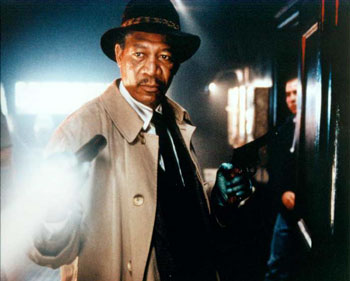
The scene opens with a wide shot of a man in his late 60’s (Morgan Freeman) in his kitchen with his back to the camera. You see him slowly buttoning up his cufflinks to his white shirt this shows the audience he is getting ready for work. Then it cuts to him in front of the mirror with a medium close up shot of him doing his tie up. This connotes that he is a well groomed man and takes care of his appearance. The camera then pans up to his face to reveal his facial expression is one of a very serious man with sadness in his eyes.


  The lighting in the room is dark and gloomy giving a dull atmosphere. As Morgan Freeman looks down, there is a point of view shot, were the audience sees through his eyes drawing them into the action. Appearing on a table there are four things a: handkerchief, police badge, a knife, keys and a pen placed in that order on the table all the objects are neatly placed this builds on the evidence of him being a meticulous man.  He picks up the police badge which connotes that he is in the police force. Then there is a brief close up shot where he grasps what appears to be keys, when he picks up the keys there is a close up on his hand where he does not have a wedding ring on this connotes that he is single, which could show that he is into his work more than his social life. He has a single bedroom apartment which means he is a single man.


There is a neatly laid out grey jacket on single bed. The bed sheets and duvet are clean and not creased. In the background we can hear the diegetic sound of the city noises e.g. police car, horning. This tells the audience of the location from what we hear perhaps a busy city. The different camera shots were used such as a close up of Morgan Freeman emphasing that he is a main character.


It cuts to a long shot him going straight to work suggesting that his work has just started. Within this mise-en-scene we see a dead body in a pool of blood, seeing this would make anyone depressed, but he takes it all in he’s stride as a professional policeman with considerable experience.

The scene starts off with Morgan Freeman walking down the corridor where he sees the dead woman laying on the floor in a pool of her own blood. Then the other colleague says “it looks like a crime of passion,” this means the person who killed the woman did it because he loved her, that is a crime of passion. “according to the detective the neighbours said they heard shouting then a GUNSHOT” the unknown detective believes this could be important evidence, but Morgan Freeman doesn’t think this, as you see in the next quotation, then Morgan Freeman follows his colleagues question by using sarcasm”YES look at all the passion on the wall”,” did the little boy see the dead body?” his colleagues replies “what kind of a F**** question is that!”. His colleague making suggestion as if Morgan Freeman doesn’t know what he is talking about  He’s colleague then follows with a demeaning statement “we are all glad when you’re leaving always these questions, questions, who gives a F***!” Morgan Freeman is not phrased by what is going on he is just focus on the job in hand.

Brad Pitt enters the scene by having a close up camera shot emphasising that he is another one of main character. There is a steadycam shot used, giving you the feeling as if you are walking on the unsteady board in the set and in the scene as in a documentary with this being a real life situation.
The scene cuts to Brad Pit and Morgan Freeman outside in the pouring rain where the dead body is coming out on a stretcher. There is yellow tap around the entrance of the apartment connoting it was under a police investigation. Brad Pit apologises for being late and interrupting. “Just got in town 20 minutes ago”. The diegetic sounds you can hear outside are police sirens, the hustle and bustle of outside life. From this scene you can see that Brad Pit looks up to Morgan Freeman. It then does another cut scene where Morgan Freeman in laying in bed what looked like he was pondering his next move with the case. There is a close up shot with the metronome moving side to side. The sounds from the metronome increase every time it tick-tocks, connoting that something might happen now. Brad Pitt has clothes which are more casual up to date with the time and very creased suggesting he is a young person who is not organised. In contrast Morgan Freeman wears smart clothes, it shows his maturity, and that he is a well organised man. The film gets the audience thinking of how these two main characters are linked with each other. Brad Pitt is eager, arrogant and just looks at the evidence that is in front him. He does not look at the deeper picture. I think he is more of an action man who goes in all guns blazing, but with less experience then Morgan Freeman.   The mise-en-scene raise a lot of questions, who is cutting their finger tips and why, which the audiences are asking for? A good opening Thriller Scene has to do this so the audience watches the movie till the end. If they get all the answers to the questions the audience will be bored, but if you leave some questions not answered it can be a cliff hanger for the audience.   Then it cuts takes straight to the next scene at the strange person house. The blurred up non diegetic sound is distorted just like the serial killers mind, also the editing and credits were the same. The text in the credits was scribbled as if an insane person had written it down on a piece of paper.  Also most criminals would use gloves, but this serial killer is so insane that he cuts his own finger tips with a sharp razor blade. All of these affects adds to the thrilling atmosphere, the main four categories are the mise-en-scene, camera shots, editing and sounds. All of these are for the audience!!!  My conclusion of the first scene is you get to know a little bit about each of the characters. I found the opening title sequence was dramatic and horrifying; it keeps you gripped and entraps you, wanting to know how the two police officers will cope with the pressure of finding the culprit.   

Genre - Similar Textual Analysis - Anthony

| | 0 comments |
Similar Text Analysis

The opening sequence of Lord of War starts off with a close up pan of millions of dirty used bullets connotating that a war had just happened and already setting the plot that it involves a big war. The camera then pans up to a man with his back to the camera wearing a suit and holding a briefcase suggesting that he is a business man, in the background we can also see burnt smoking cars still on fire suggesting that powerful and devastating weapons were used to be able to create this much damage and that whoever destroyed the cars is very dangerous. The man then turns around and the camera then zooms onto his face where we can see how neat and tidy he is and that even his hair is still combed connoting that no one wants to mess with him and is scared of him or maybe he is a neutral party to the sides who just had the recent conflict. Then in direct address to the audience he says ‘there are over 50 million fire arms in circulation, that’s one fire arm for every 12 people on the planet the only question is (he then brings a lit cigarette to his mouth and breathes it in showing how calm he is even in this war zone) how do we arm the other eleven’ connotating that he sells guns and that is his business.                
                                                                                                                         
The scene then cuts to a high angle shot of a roof and the camera pans down to reveal a dull grey facility with a lot of machines connotating that it’s a factory, the names of the creators and actors then start to slowly fade in and out on screen and it is done in a small text in the centre of the screen so that your attention is kept to the actions going on in the scene but you can still see the people involved in the film such as Nicholas Cage which would make this movie appealing to people who are just fans if him. The camera then zooms onto a machine and phases through the machine into the insides and the title of the film fades in all block capitals which connotates the military and seriousness. The camera then switches to a point of view shot of a bullet while in the background the song ‘for what it’s worth’ is playing which is a song known to be in protest of war which is incidental music and suggests that there will be mixed feelings towards war in this film.    
                                                                                                
There is then an ellipsis of the bullet on its journey and at one point we see a man in uniform and hat with a lot of red on it connotating that he is a high ranking soldier in the Soviet Union army. The next few scenes take us to a sunny and exotic place where we see that all the people are black with very dark skin connotating that this is in Africa we also see that they are holding guns and in particular AK47’s connoting that they are rebels from a resistance group as the AK47 has been noted throughout conflicts in history as a symbol of resistance such as in Cuba, Vietnam and the Taliban, the ellipsis continues until the bullet is spread onto the floor with other bullets and then they are placed into the chamber of a gun. The diegetic sound of gun shots connotate that there is a battle going on and that this movie will contain violence and death, the bullet which we still see in a point of view shot is fired from the gun and we follow it as it heads towards a young boy who does not show any emotions suggesting that it happened so quick that he didn’t even realise what happened and that he was not even involved in the conflict but was caught in the crossfire.                   
                                                                                            
The scene then fades to into shot of the sea from a high angle bird’s eye view. The camera then pans down to an extreme long shot of a man standing in the middle of a dock and then narration follows connotating that the man narrating is the same man in the shot connotating that he is a loner and that he enjoys to be alone as he purposely chose to go to an area where he would be in seclusion. Next the camera cuts to a low angle shot of the back of the man and the camera slowly tracks three hundred and sixty degrees around him to reveal his face and we can see that it’s the same man from before. However unlike the suit he was wearing before he is now wearing a plain shirt and trousers and his hair is scruffy connotating that these events took place before the time where we see him at the beginning and that at the moment he does not have much money.                                                                                                     

The camera then cuts to a shot of a women wearing a crown and wearing a sash that says ‘miss long island’ riding in a car with confetti being rained down on her and a big crowd of people cheering connotating that she is a beauty queen and that she just won the long island beauty pageant. 
                                                                                                                 
They then have a close up shot reverse shot of the beauty queen and the main character to show just how infatuated he is with her however we learn it is only one sided when he says “I’ve worshiped Eva Fontaine since I was ten years old of course she didn’t know I existed” this also connotates that the main character believes that he is no one special and has no attracting qualities. The camera then cuts to a shot of a subway train, the camera then pans across and cranes and tilts to reveal the main character entering a building with foreign text and stars of David on it connoting that the setting is taking place in New York as the subway is associated with New York as it is such an important part of the city, the camera movements from the tack to the building shows us just how close they are to each other and suggests that it is set in a rundown part of the city. The foreign language and the start of David connotes that the character is both foreign and Jewish giving the audience an insight into the beliefs of the character. 

Throughout the whole opening there is continuity editing used throughout and this helps to create a flow and it lets the audience follow the story of the main character as he progresses.                


In conclusion I would say that the first five minutes of Lord of War tells us a lot about the movie in that it involves a man who rises to wealth and power and that he does it through selling guns.  


Genre - Similar Textual Analysis - Zamu

| 1 February 2011 | 0 comments |
Similar Text analysis: The Exorcism of Emily Rose


Introduction:

The Exorcism of Emily Rose is a horror film that can be put under the subgenre of religious/supernatural thriller. The target audience is for 15 years and above.
The film is based on the true story of Anneliese Michel and follows a self-proclaimed Agnostic defense lawyer representing a parish priest named Father Moore who is accused by the state of negligent homicide after he performed an exorcism on Emily Rose who believed she was being possessed by six demons. A day after the exorcism, Emily dies. The film, which largely takes place in a courtroom, depicts the events leading up to and including the exorcism—and ultimately her death—through flashbacks. There is a battle between science and religion in the court.

This plot is conventional of a supernatural thriller in which we have a protagonist (Emily Rose) battling an evil paranormal force (The Devil himself).

The theme that occurs in the film is the power of evil in the sense that the demons within Emily battle to overpower her and possess her. She tries to gain power over them through the use of medication and an exorcism but she fails to win. This theme highlights the ideology of the film which is supernatural evil always finds a way. Although Emily (just a human being) tried to defeat the demons within her, they found a way to control her and eventually lead her to death because of their supernatural powers. Their powers were too great of a force to be reckoned with.
There is use of motifs to represent the suffering of Emily Rose. Especially in the opening sequence in which we hear the same agonnising screams every time the topic of her exorcism is mentioned. We don’t see her at the beginning of the film but hearing the cries and screams every time she is mentioned indicates that the cries ands screams belong to her.

The Catholic religion is held under a magnifying glass in this film and is the main reason to why the exorcism took place. The religion implies that illness can be cured by prayer which in this modern day and age would seem silly when there are medicines that are proven to work for mental health. Catholicism is also represented as evil because even though Emily is shown and represented as an innocent, obedient, devoted, young catholic girl, the demons still choose to possess her which can be perceived as unfair, unjust and plain evil. Also, because Emily dies at the end, it represents the religion as highly dangerous because even the good are punished.
Another take on how the religion is represented is by the scientists and doctors who believed that the supposed demons possessing Emily were all bogus and that proven test clearly diagnosed Emily as epileptic and psychopathic explaining all her outburst. This implies that the catholic religion is in some ways fictional and untrue as it’s symptoms for being possessed by demons is explained by science which says that the symptoms of being possessed are ones of being epileptic and psychopathic not being possessed.

This dispute about religion and the supernatural realm are typical of a Religious thriller which entails evils unleashed and ancient scriptures coming into play. At times they are quite controversial as they examine people's beliefs, not always in a flattering way.

Analysis:
The opening sequence of the film, we are given a typical title sequence with credits. To add a thriller/horror feel to the titles, they appear in a small font at corners of the screen for around 3 seconds and then fade away quickly creating a spooky effect, almost ghostly. With the titles we hear incidental music that is slow and sinister sounding with the use of string instruments such as violins. This music sets us up to be scared and builds tension. After the titles, the screen remains black to which we then hear the screams and cries of what sounds like a girl. We then hear a girl shouting with anguish and pain ‘Emily!’ Then we hear a manly, demonic laugh to which the screen then fades into white and we hear the girls high screams and cries again. These voices put together sound like a girl is being torn apart by an evil man. It creates tension in the audience and heightens our hearing as we cannot see what is going on except for hearing the screams making us imagine what disturbing thing could be making this girl scream like that.  The white screen then fades into the main title of the film. ‘The Exorcism of Emily Rose’ in a bold, gothic, crimson font typical of a thriller film. The girl named Emily is going to have her blood spilt as the colour red connotes danger, blood, and death. The title is also placed in-between barbed wires which also suggests danger and is somewhat of a sign saying ‘keep out’ as barbed wire is what we use in society to stop people going into designated areas, areas that are harmful and dangerous.

After the title, we are taken into the first scene of the film through cuts that first show dead crops moving in the wind and dead pumpkins frozen on the ground. This shows that the scene is set on a farm but also foreshadows the underlying theme of death because all the props are dead. The pumpkins also indicate that the film is taking place in Halloween as that is the time when pumpkins are grown.

We then get a bird’s eye view of the scene in which we see a house that looks like its derelict and abandoned and we see a man dressed in black walking up to the house.. The incidental music continues to play again. It plays in a major and minor key creating suspense, tension and a very saddening atmosphere. This shot establishes the scene but more importantly tells us what we can expect to come in the film. The derelict building suggests that it is unlivable in and the man dressed in black has probably something to do with death. The black clothing covers his whole body which represents him as maybe a bearer of bad news because black is a very dull, depressing colour that connotes death, evil and is the exact opposite of happiness. Throughout this shot we hear the heightened ambient sound of the gushing of wind which shows that it is clearly winter time. The house is also surrounded by fog which also shows its winter. The fog also adds to the spooky effect of the scene and gives a ghostly feel to the house as ghosts usually appear to be misty and white like fog.

When the man is walking up to the house he looks at the barn/garage opposite it. We get a close up of his face to show that he is inquisitive and then the camera cuts to the barn/garage which has a moving compass on its roof. Just as the man in black looks at the garage, the compass makes a rusty, creaky sound that is heightened as it moves pointing into the direction of the house. This is very spooky as it moved instinctively almost to say that what ever made it move doesn’t want the man to enter the garage or wants the man to go into the house even though it looks abandoned. Once the man eventually is let into the house, we get a mid long shot from the man’s point of view of  a woman at the door asking him if he is the medical examiner to which confirms that his profession is to do with dead bodies (death).

When the medical examiner walks in, he is directed into a room to which he greets a man saying ‘Mr. Rose’. Behind Mr. Rose is a wooden cross hanging on the wall suggesting that the people in the house are Christian and represents them as religious. There is a prolonged use silence after as the medical examiner is then lead up the stairs into a room to which we hear the diegetic sound of his footsteps heightened and the incidental music heightened. This creates a build up of tension and indicates that he is about to do something of an unpleasant nature. He is represented as the bearer of bad news. When he comes back down, we get a close up of a pendulum clock ticking and its tick is also heightened and stays emphasized through out the scene. This may indicate that the film has also something to do with time. It is very much an enigma. The camera then gets a close up of the medical examiners face to which he looks confused, puzzled, and scared. This shows that he what he has seen is something unusual and worrying. He even stutters when he says- ‘sorry Mr. rose, but I can not stay conclusive that the cause of death was natural…your daughter…’ The examiner implies that Mr. Rose’s daughter was either murdered or killed and does not finish his sentence emphasising that his daughter died tragically and painfully as he can’t bring himself to say the details of how or what made her die. The camera then cuts to a close up of Mr. Rose as he turns his face to look at the examiner and his is somewhat emotionless and slightly angry looking. This represents him as hard and manly and because he does not reply to the examiner it suggests that he is actually angry using silence to show it but also suggests that he probably knows the real reason why his daughter died such a horrible death.

The camera then cuts a to a man dressed as a priest. We get a close up of his face and as he turns his head to look out the window we get his point of view shot of the garage in the exterior of the house. The incidental music heightens again suggesting that he had something to do with the death of Mr. Rose’s daughter and also creating a mystery feel as to how and why the daughter was killed. To end the opening scene, while the camera still has the garage in frame, we hear the sound motif of the suffering of Emily, she is screaming in pain just like the screams we heard when the titles were being shown bringing the audience back to the remember that Emily was killed and in a lot of hurt and pain.

There is good use of continuity editing from the editor as each scene flows logically from the title sequence to the exterior of the house and then to the interior of the house. The editor also effectively creates tension right from the beginning of the film when the incidental music is played loudly and then fades under when we hear the agonizing screams of Emily rose in the title sequence and when other characters speak. The way the editor also chooses to consistently use the major key for the incidental music while randomly inserting a short play of minor key creates an eerie, scary atmosphere as the contrast between the way the major key and minor key very great.

The editor’s use of long takes along with the incidental music being played builds suspense at the beginning of the film. The long takes really establish the spooky setting of the                            house and allow the audience to analyse the scene and understand what exactly is going on in the film such as why the medical examiner is entering the house and why there is a priest in the house. The long takes also indicate the slow passing of time which creates mystery, emphasising all the little but significant action that takes place within that five minute scene.
The editor’s choice of cuts is also very premeditated, cutting to significant objects and props that indicate to the audience the importance of those objects in the film. There are significant cuts to the crop establishing the setting and in the interior of the house, there is a significant cut to cross telling the audience that this is a Christian household and there is cut to the pendulum clock which foreshadows that time is going to be an important element in the film. Further into the movie we find out that Emily would start displaying signs of being possessed at exactly 3:00 am in the morning.

As for the clothing of the characters, most of them are wearing dark colours connoting the time period, which is the olden days and so they fit in with the general dark and depressing atmosphere of the movie. Their clothes are also simple and look like they have been made from natural materials, showing that they work on a farm and that they are self-sufficient and poor.  The father is wearing normal clothes, not crying, also suggesting he hasn’t come to terms with his daughter’s loss.

Emily’s sisters who are seen in the first five minutes mourning Emily’s death are wearing very neutral light beige and peach colours, this maybe gives us an idea of how Emily would have dressed. These colours connote youth, femininity, and innocence which is what Emily would have been like before she became possessed.

Further on in the movie the Emily, who gets possessed, is, wearing a white gown, this stereotypically, represents purity but in this case she is getting possessed by the evil darkness of the devil which makes a striking difference between these colours. 


Genre - Similar Textual Analysis - Jasmine

| | 0 comments |
‘The Butterfly Effect’ is a physiological thriller (5 min text analysis)

The first thing we see in this film is the distribution company’s logo and theme music which is 'New Line Cinema', the studio logo is 'Aol Time Warner Company'. Portraying that the film is a major Hollywood Production. Once the film starts a superimposition of white text is used which fades up on a plain black screen, making it stand out and easily visible showing its importance. It is a quote from the 'Chaos Theory' which describes a "flutter of a butterfly's wings". Telling us that this enigma code must be relevant to the film and so may be what the film is based on, giving the audience something to think about. While the quote is on the screen we hear a sound of fluttering butterfly wings emphasizing the feeling of being scared and anxious. The sound and quote link together which makes the scene tenser. Discordant sounds of violins have been used overlapping each other with the same constant obtrusive paced tune giving us a sense of anticipation which makes us feel nervous.

A cut has been used taking us to the next scene; the only thing visible is plastic blinds. This co-notates that something is going to happen; it holds importance and suspense to the sequence the film has been edited in. The camera tracks along the blinds and a blur passes by, this makes us want to follow it, to see what it turns out to be. It moves fast almost ghostly and unrecognizable which makes us judge and question the humanity of the character behind it. Once the blur gets to the door you can’t tell who it is or make out any physical features yet you can just about tell it’s a man because you see defined muscles giving a very masculine shape. This tells us he is strong representing men stereotypically due to his manly structure. The scene fades out fast like a blackout. You see and hear him kick the door making the audience jump with fear from the loud bang as it was unexpected.  It also tells us he is in a hurry and the door must have been locked otherwise he would have opened it normally. Shutting the door in a rush he pushes a couch in the room to block the entry emphasizing he wants to be alone. He then takes a small box (of his belongings?) unknown to what is in there the audience is left assuming what it could be. He hides under a desk telling us he is frightened and co-notates that someone may be following him. It also tells us he isn’t the one in control the other men are. We hear the wind blowing which sounds eerie and gives us a scary vibe. It also adds to the supernatural view making it seem more ghostly and unordinary.

He starts writing on a notepad and speaking out aloud as his writing presenting his thoughts which increasingly add tension to the film. It makes us realize what he is saying is important which makes us listen even more carefully. Using a shaky, stiff mode of address when speaking aloud telling us he is scared and in a hurry. He says “if anyone finds this” which suggests he is writing a letter or diary. This gives us an intense feeling as he prepares us for his next words. There is a mid-close up of the man showing us his emotions. At this point he is shaky giving us the suggestion that he is nervous and ill. It also gives us a chance to look at his features closely; he has long curly hair and stubble co-notating he hasn’t been out for a while and doesn’t take complete pride in his appearance. This also tells us he is lazy and under-maintained which are another stereotypical view people have on the male gender. We see him wearing a blue robe co-notating he is in some type of hospital. He then looks to the side and we see a close-up of his face, you can see his nerves rising making him become more stiff suggesting that people he doesn’t want are nearby. He continues to speak aloud what his writing on the notepad he says “I’m already dead”. This tells us something big is about to happen and creates tension. It then cuts to the blinds and we can see torches and men telling us that they are looking for him suggesting he has run away from wherever he was before. It then cut back abruptly to the man hiding and gives us a close-up of the page he is writing on suggesting it is important. It zooms into the notepad till it focuses using an extreme close-up on the words “save her” which makes the audience confused because we are left wondering who? And what he is talking about. The notepad adds to the visual effects of the film. This is done as the paper tears up slowly as if it is floating then it blurs and you can see paper butterflies and hear their flittering noise. This emphasizes the theory that was quoted in the beginning, it links together keeping it flowing continually.

The name of the film appears on the screen and the butterflies fade into one flittering butterfly which later on fades into a brain scan. Co-noting that it is a physiological thriller and the movie has something to do with a brain and the way people think. The music in the background sounds like agitated butterflies and is very loud almost nerving and disturbing for the audience. This is a parallel sound as the flittering and butterfly compliments each other as a sound motif has been used to link them to the theme, emphasizing that it is one of the main points of the movie. So the audience can really relate the movie to the theory and understand it better. The butterfly and sound eventually fades out co-noting that the film is about to start.


Next there is a scene of a wealthy living area with big houses telling the audience that the residents nearby must have money and be higher in society. Using a shallow depth of field making the audience concentrates on the two black dots riding downhill the road on bicycles. This takes the audience on a journey of the area which establishes the setting. As they ride closer to the camera it pans to one of the houses. Seeing a young boy playing with a dog suggests when the title scene faded out we travelled back in time to see why he was writing. The previous scene also seems to be an action match as it makes two scenes flow and connect in the most realistic form. This tells us the end must be the beginning. This was done subtly, telling us it is a normal day in his childhood life. His mother calls him “Evan” he runs to her where she is standing by a car with the hood open suggesting she is fixing it, this shows the women to be stronger as she can do a ‘man’s job’. Evan says “we are going to be late again” suggesting they are usually late telling us they are a laid back family. Using shot reverse shot and eye line matches to show and make it clear they are talking to each other. Evan asks “is dad going to come?” this tells us that isn’t usually around his mum replying “it’s too dangerous for him” this shows that his father must have something wrong with him if it’s dangerous to be out, also suggesting he isn’t anywhere near. Evans response is “but Lenny says his dad is coming and Tommy and Kaylie’s” this portrays that Evan misses his dad and feels left out this is done to make us feel sorry and sympathize with him. This portrays him to be a stereotypical child that likes to ask questions and compare himself to others showing he is unsure of himself. The car engine turns on which is sound perspective as we can tell it’s close by but we can’t see it emphasizing women to be the stronger sex at this stage as she fixed the car and it works fine.

We then see the car moving and it stops mid close up from the camera showing us Evan and his mother in it and the tension that was built up from the previous scene. His mother is very loving and caring as he leaves the car she says “I love you” and Evan keeps quiet the silence revealing he is unhappy that his father isn’t allowed to come it shows us he doesn’t completely understand why. However as the school bell rings he waves showing that he still loves her which overall tells us in a mother son relationship the mother is always in control and the child can never stay angry with her. As his mother is about to drive away you see a lady smartly dressed knock on the window of the car, while she’s rolling down the window the lady says “I think you really need to see this”. It cuts to the classroom which is full of children. As the teacher walks in she scolds Tommy as he is hitting Lenny portraying he is a bully. Shot reverse shots are used to show the mother and teacher talking. The fact she says “I was going to show it to the principle” tells us it is something important. She pulls out a drawing and gives it to the mum. There is close up showing us what the drawing is about and telling us it is very important and holds great importance in the scene. Then a worm eye view has been used showing the mother looking at the picture baffled that her son drew the picture and he didn’t remember it. This shows us the worry on her face suggesting she has seen this before. This can be similar to the father’s situation?

It cuts to a building at night ‘Sunnyvale Institution’ telling us his mum thinks he’s got a mental illness or something linking to the brain in the title at the beginning. We can see Evan is scared of what is about to happen and that he doesn’t like going to this place in his expressions, he also mentions he finds it “creepy”. It cuts juxtaposing an eye which pulls focus to Evan’s head going into a MRI scanner. We see a close up of his face showing the blankness in his eyes as they are opened wide showing he is afraid.


Genre - Forms and Conventions

| | 0 comments |
Forms and Conventions (Anthony)

Thrillers are one of the most popular types of genre in the film industry as it appeals to so many people. A thriller is characterized by fast pacing, frequent action and resourceful heroes who always overcome a more powerful villain with suspense and cliff hangers throughout the story.                                                                                                                             
Thrillers are often set in foreign cities and exotic location or places where the weather conditions are extreme for example in the Polar Regions or in a desert for example the James Bond series, ‘National Treasure’, ‘Frozen’, ‘Green Zone’ and ‘Mission Impossible’.The hero of the thriller is usually portrayed as a tough and manly individual such as police or soldiers, however normal ordinary people are also used to relate more to the audience. In a lot of thrillers there is also a sense of mystery added to increase the tension in the story though there is a difference between the mystery in a thriller and a mystery film in that in a thriller the hero must stop the villain while they are still carrying out their crimes while in a mystery film the hero uncovers the truth of a crime already committed.


Another convention of a thriller is that everything happens on a grander scale for example the crimes that must be prevented might be mass murder or terrorism and the thriller only climaxes when the hero finally confronts the villain and beats him usually saving his life and the lives of others.                                                                   


Horror thrillers have become more popular recently; a monstrous element has become common to heighten tension. With the changes in the horror genre the monster could take on many forms such as a serial killer, an alien or even a deadly disease however all monsters have something to make it distinct. For example some monsters have a high intellect (Hannibal lecter), supernatural power (Penny Wise) or a particular weapon (Jason Voorhees machete).                     


The reason why thriller is so appealing is because it is diverse and has many sub genres such as a spy thriller in which the hero is generally a government agent who must fight against a terrorist. There are also conspiracy thrillers in which the hero confronts a powerful group of enemies whose true extent only he or she recognizes. Political thrillers where the hero must ensure the stability of the government. Crime thrillers which are more focused on the villain rather than the hero and action is more frequent in these then psychological aspects. Legal thrillers where the hero is mainly a lawyer and they confront enemies both inside and outside the courtroom. There are Erotic thrillers that involves erotica and thriller. Horror thriller which involves conflict between the main characters are mental, emotional and physical, the main aspect of a horror thriller is that there is a constant element of fear throughout the story. Psychological thrillers where the conflict between characters is purely mental and emotional. There are supernatural thrillers in which the conflict between characters involve a supernatural power, supernatural thrillers are a combination of tension with conventions of horror, however supernatural thrillers don’t tend to show much gore like horrors it is all about the mood of menace and unpredictability. There are also Techno-thrillers where the story focuses on technology, usually which are military technology which is described in detail and made essential to the viewer.
In most thrillers the story is all about justice VS injustice and that often there is a price to be paid for the conclusion of the story for example the hero may have to sacrifice themselves for others to live.

The conventions of a thriller include 
-          The Protagonist at the mercy of the antagonist at the beginning of the film. 
-          An easy shock generated by a sudden unexpected action. 
-          False ending, where all appears to be alright. 
-          Speech in praise of the antagonist which is often done the protagonist and is used to build up the villain. 
-          Things are made personal when the hero’s personal life is brought into it. 
-          Not showing everything to the audience making them build up their own interpretation of events

Forms and Conventions (Zamu)

Thrillers are mostly characterised by an atmosphere of menace, violence, crime and murder by showing society as dark, corrupt and dangerous, though they often feature a happy ending in which the villains are killed or arrested.


These are types of films known to promote intense excitement, suspense, a high level of anticipation, ultra-heightened expectation, uncertainty, anxiety, and nerve-wrecking tension. The tension usually arises when the main character(s) is placed in a menacing situation or mystery, or an escape or dangerous mission from which escape seems impossible. Life itself is threatened, usually because the principal character is unsuspecting or unknowingly involved in a dangerous or potentially deadly situation. Plots of thrillers involve characters which come into conflict with each other or with outside forces - the menace is sometimes abstract or shadowy.
These include such genres as mystery, detective movies, gangster movies, crime, spy films, science fiction, film noir, occult and haunted house horror movies.
In the ‘40s and ‘50s, film noir controlled the thriller, painting an increasingly pessimistic, sinister view of life. Characters trapped by fate and downbeat endings were common, and moody, gloomy visual atmospheres were the key elements. After World War II, thrillers became increasingly more menacing (with films by directors like Nicolas Ray, Samuel Fuller, Alfred Hitchcock, Don Siegel, and international filmmakers like Jean-Pierre Melville, Henri-Georges Clouzot and Akira Kurosawa), but the gory, explicit violence and overt sexuality that define much of the genre today didn't arrive until after the Hayes Code was abolished in 1969. Since then the genre has been stretched with films by various directors who each continue to twist and expand thrillers into new areas.


With Psycho, Alfred Hitchcock merged two very different genres: the horror film and the thriller. After Psycho in 1960, the cinema was never the same again. The story which frightened audiences worldwide is of a young man (Anthony Perkins) who, on the one hand leads a perfectly normal life as a struggling motel owner and, on the other, becomes a homicidal maniac when he impersonates and dresses as his long-dead mother. To keep the memory of his mother alive he keeps her stuffed skeleton in the cellar. When a young woman (Leigh), on the run with $40,000 appears for a night’s stay at the motel, the scene is set for Norman Bates to go into action. The dark figure with the knife outside the shower curtain is just the beginning.

Sub genres:
Crime thriller:
·         The Lodger (1944)
Science fiction:

·         Alien (1979)
Action Thriller:
These films are characterized by fast-paced, hero-centered narratives full of action and excitement. They often have elements of mystery and crime films, but these elements take a back seat to the action.
  • Die Hard (1988)
  • The Hunt for Red October (1990)
  • Point Break (1991)
  • Cliffhanger (1993)
  • Air Force One (1997)

Conspiracy Thriller:

Only the hero knows the truth about a particular person, group, or situation, and he or she must prove it to the rest of the world before disaster strikes and the bad guys win.
  • The Manchurian Candidate (1962)
  • The Conversation (1974)
  • JFK (1991)

Crime Thriller:

These films often focus on criminals dealing with a successful or failed crime and the suspenseful results. Common themes include robberies, murders, and double crosses.
  • Double Indemnity (1944)
  • The Usual Suspects (1995)
  • Sin City (2005)
  • No Country for Old Men (2007)

Disaster Thriller:

These films deal with some type of disaster, either natural or man-made. Along with sometimes showing the disaster itself, these films concentrate on the chaotic events surrounding the disaster, including survival strategies and the effects on the characters and their loved ones.
  • Deep Impact (1998)
  • Final Destination (2000)
  • The Day After Tomorrow (2004)
  • Cloverfield (2008)

Erotic Thriller:

A sensational genre that is a mix of erotic and thriller films.
  • Body Heat (1981)
  • Fatal Attraction (1987)
  • Basic Instinct (1992)

Legal Thrillers:

In which the main character is a lawyer and must confront enemies outside, as well as inside, the courtroom. These heroes are in danger of losing not only their cases but their lives.
  • A Few Good Men (1992)
  • The Pelican Brief (1993)
  • A Time to Kill (1996)

Medical Thriller:

In these films the hero is a medical professional struggling to solve some type of dangerous/frightening medical problem.
  • The Andromeda Strain (1971)
  • Coma (1978)
  • Awake (2007)

Psychological Thrillers:

The ones that mess with your head. In these types of thrillers the suspense is character-driven rather than action-driven. Characters play deceptive games and try to destroy one another. Sometimes the conflict exists within one character's mind.
  • Freaks (1932)
  • Laura (1944)
  • Jacob’s Ladder (1990)

Political Thriller:

The main character must ensure the stability of the government that employs him or her against enormous odds.
  • Notorious (1946)
  • The Crying Game (1992)
  • In the Line of Fire (1993)
  • Valkyrie (2008)

Religious Thriller:

Thrillers based on religious teachings, events, and customs. Religious prophecies, evils unleashed, and ancient scriptures often come into play. At times they can be quite controversial as they examine people's beliefs, not always in a flattering way.
  • The Omega Code (1999)
  • The Da Vinci Code (2006)
  • Angels and Demons (2009)

Spy Thriller:

The hero is usually a government agent who must take violent action against agents from a rival government or terrorists.
  • Mission Impossible (1996)
  • The Bourne Identity (2002)

Supernatural Thrillers:

These are very similar to horror films, but are often not as violent. The character (could be the hero or the villain) has some sort of supernatural power that must be called upon. Supernatural thrillers often find the protagonists either battling an evil paranormal force or placed in a situation controlled by another-worldly force beyond their comprehension.
  • Cat People (1942)
  • Carrie (1976)
Most thrillers are formed in some combination of the above, with horror, conspiracy, and psychological tricks used most commonly to heighten tension. The sub-genres overlap and can be put into several different categories. All of them create tension, suspense, and excitement for the viewers.